

Blog
How to Decarb Weed: A Complete Beginner’s Guide to Decarboxylation

If you have tried making your own marijuana edibles and the results didn’t seem to work the way you thought they would, then chances are you skipped an important step during the preparation of your marijuana products – decarboxylation. This is an important step before you can infuse your marijuana into anything. It is very important to know exactly what decarbing marijuana is and how you can effectively do it yourself without any special equipment.
What Does It Mean to Decarb Weed?

Decarboxylation, often referred to as “decarbing,” is a procedure that uses heat on raw cannabis to make it ready for use. The fresh cannabis flower has THCA (tetrahydrocannabinolic acid), which is not intoxicating by nature. THCA will not make a person feel “high,” even if they consume cannabis containing THCA alone. THCA turns into THC (tetrahydrocannabinol) when it is subjected to heat. If you’re unfamiliar with different cannabis flower types, read our guide on the Difference Between Sativa and Indica.
This is why smoking or vaping cannabis makes a person experience a “high” immediately. If you’re comparing different consumption methods, check out Smoke vs Edibles vs Modern THC Products because the flame decarbs the flower in the very first instance of its burning. However, when one wants to prepare edibles from cannabis, then since there is no flame at all, one has to decarb cannabis in an oven. To sum up, decarbing is the step between raw material and a usable component.
Why Is Decarboxylation Important?
Omitting decarboxylation is probably one of the most common mistakes made when making homemade edibles. Here is how skipping this step affects the result:
- Activation of cannabinoids: is what makes cannabis effective for infused recipes and edible cannabis products.
- Consistency in dosage: Properly decarbed cannabis helps you calculate dosing more easily and more precisely.
- Taste and consistency: The decarboxylation process also removes excess moisture from the flower, which can affect its consistency during infusion.
- Slightly increased shelf-life: The decarboxylation process might extend the flower’s shelf-life after you’ve ground it.
In other words, this process is what sets edible “that does nothing” apart from a good one.
What You Need Before Decarbing Weed
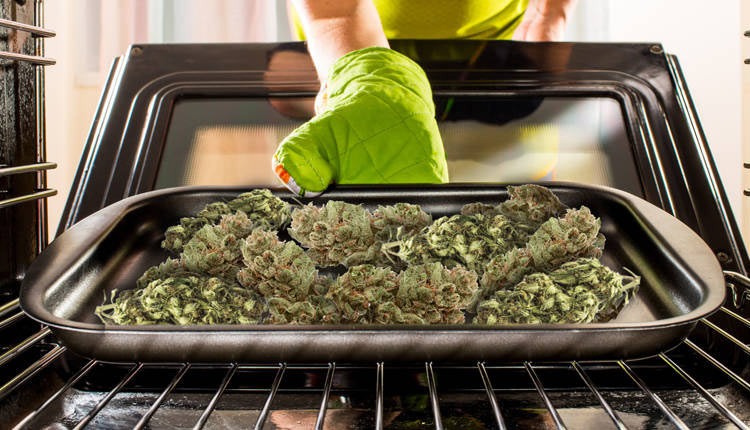
Decarbing is an easy task; however, having the proper equipment will simplify and standardize the process. Below is a list of necessary items needed for decarbing:
- Cannabis flower or trim – (preferably quality THCA flower) works best for consistent decarboxylation.
- Oven – any household oven will be enough for the job.
- Baking sheet or oven-safe tray
- Parchment paper – for non-stick purposes and easy cleaning.
- Oven thermometer (recommended but optional) – as some ovens may have inaccurate readings.
- Grinder or hands – for crushing the cannabis flower into smaller bits.
- An airtight container – for preserving the decarbed cannabis after cooling it down.
Having everything prepared beforehand will help you perform the task quickly and easily.
How to Decarb Weed Step by Step

Let’s now see how the whole process actually unfolds. This method is compatible with most domestic ovens and is the most commonly used procedure when it comes to decarbing cannabis.
Step 1: Pre-Heating the Oven
The first thing you should do is to preheat the oven to the desired temperature level. Usually, it is advised to set the temperature anywhere from 240 to 250 degrees Fahrenheit (from 115 to 120 degrees Celsius). The importance of the pre-heating stage lies in the fact that putting the cannabis into the not yet heated oven might result in an uneven decarboxylation process when one part of the THCA would convert slower while another one would overheat trying to compensate for it.
Step 2: Breaking the Cannabis into Smaller Pieces
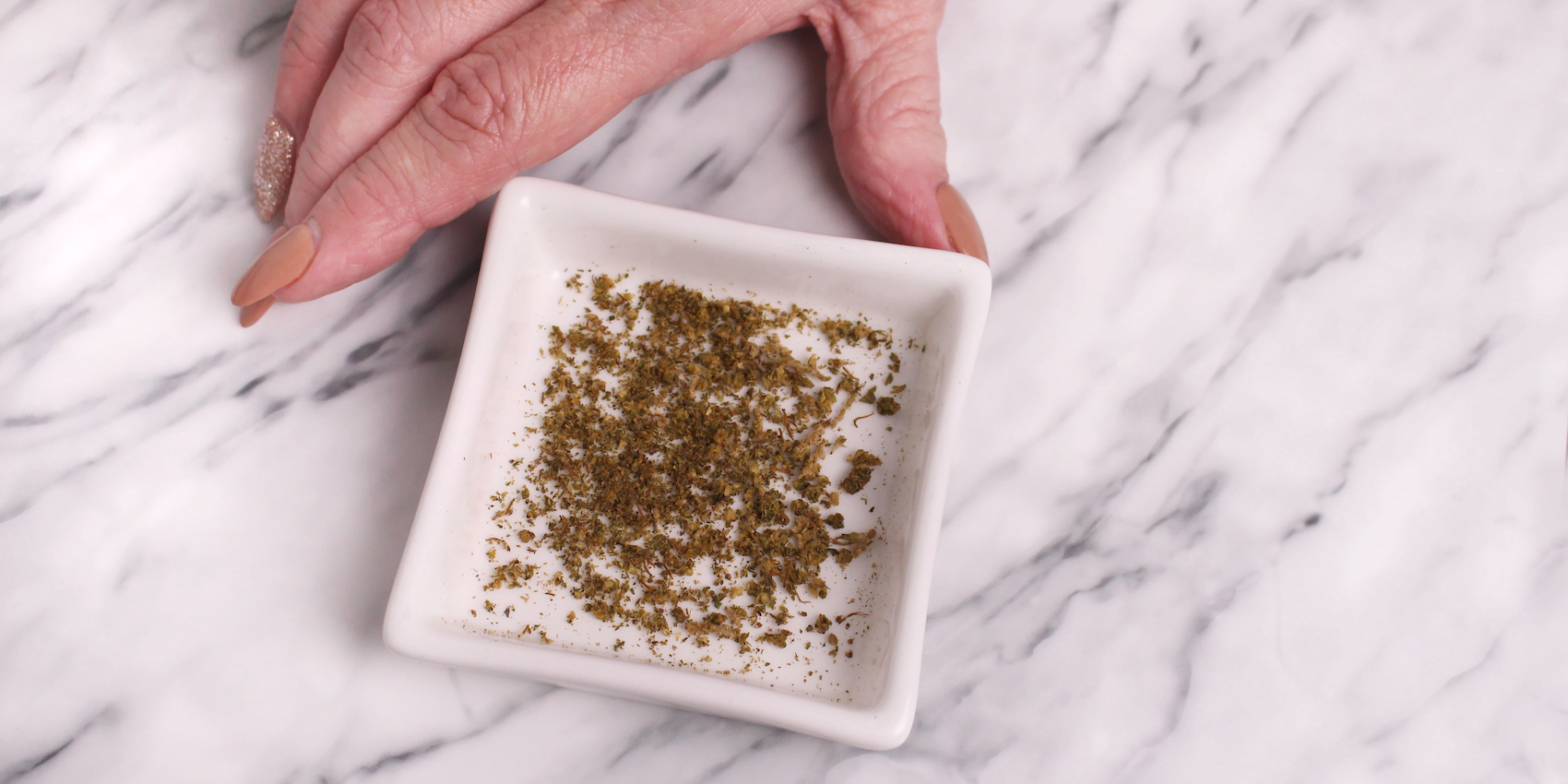
Use the grinder to break the buds down into smaller pieces or just break it manually. There is no need to grind it to dust; pieces that are about the size of a grain of rice up to the size of a pea will be perfect. By breaking down the flower, we make the surface available to heat more, thus allowing a better conversion process to take place.
Step 3: Even Distribution on the Tray
Line your tray with parchment paper and evenly distribute the broken cannabis on the tray. Do not pile it up or let the pieces of the cannabis overlap, as decarboxylation won’t happen uniformly and the pieces placed on the outer side would decarb faster than the inner pieces.
Step 4: Bake at Suggested Temperatures
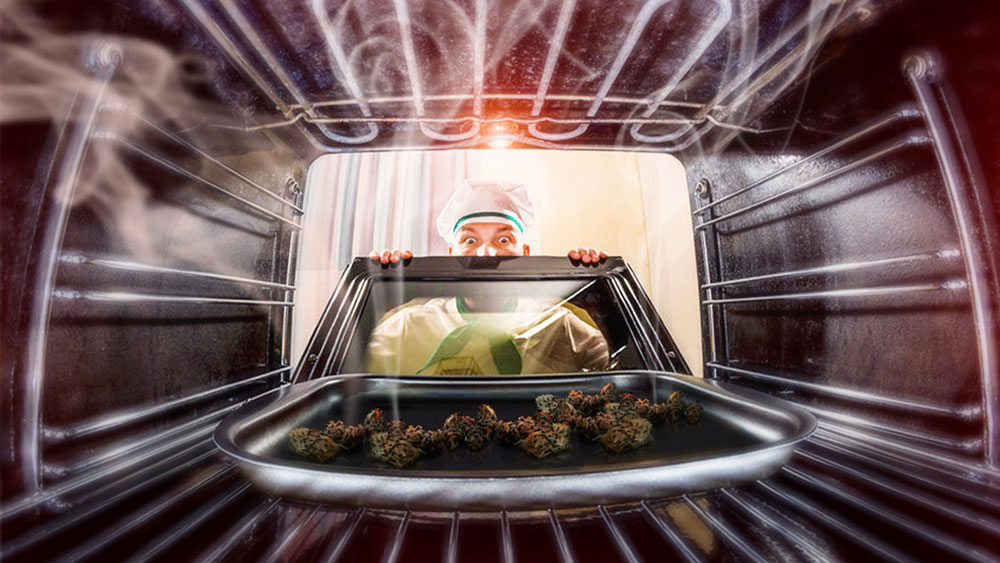
Bake the tray in the preheated oven for approximately 30–45 minutes before using it in homemade recipes such as brownies, cookies, or chocolates. Browse our THC Edibles Collection. During the process, the cannabis will change color from the bright green to the light-to-moderate brown, and will become dry and fragile. The slight toasting smell is okay.
Step 5: Allow It to Cool Down
After the baking process is done, you should take out the tray and allow the marijuana to cool down completely. The cannabinoids are less stable when the cannabis is hot, so grinding or infusing it right away might cause a slight decrease in potency. After that, place it in an airtight container until you are going to infuse it into your base.
Best Temperature and Time for Decarbing Weed
Getting the temperature and timing right is the difference between properly activated cannabis and a batch that’s either under-decarbed or scorched. Here’s a general breakdown:
| Temperature | Time | Result |
|---|---|---|
| 220°F (105°C) | 45–60 minutes | Gentler activation, preserves more terpenes |
| 240°F (115°C) | 35–45 minutes | Balanced approach, commonly recommended |
| 250°F (120°C) | 25–30 minutes | Faster conversion, slightly higher risk of degrading flavor |
Lower temperatures over a longer period tend to preserve more of the plant’s natural terpenes, which contribute to flavor and aroma. Higher temperatures speed things up but run a greater risk of burning off some of those delicate compounds, along with a portion of the THC itself if left too long. Most home cooks find that a moderate temperature around 240°F for about 40 minutes strikes a solid balance between efficiency and quality.
Different Ways to Decarb Weed
Although the oven method is by far the most popular, it’s not the only choice you have. Depending on the tools you have and the level of precision you need, either of these other methods might be more appealing to you.
Oven Method
The traditional and most convenient way to decarb cannabis and the one described at length above. Doesn’t require any specialized tools, which makes it the default option for novice users. The only potential problem is the variability of temperatures inside the oven, so the use of an oven thermometer is highly recommended.
Mason Jar Method
In this case, the ground marijuana is placed inside a tightly closed mason jar, which is then baked in the oven, sometimes on top of a folded towel to avoid direct contact with the hot tray. The enclosed space will help to prevent odors of decarboxylation from spreading out and might preserve some terpenes from escaping into the air. However, heat transfer through the glass is slow and inefficient, meaning that the right timing is hard to predict.
Method of Sous Vide Decarboxylation
If you own a sous vide immersion circulator, this will be an ideal way to regulate temperatures. The cannabis ground is placed in a vacuum-sealed bag or zip-top bag through the water displacement process and put in water at a certain temperature of about 200°F (93°C) for one or two hours. As water maintains the temperature better than air, this method yields fairly even results, maintaining aroma and flavor, too. Coincidentally, this method also works perfectly well if you want to decarboxylate cannabis into oils, as it will be followed by the infusing process.
Decarboxylation Device
Special decarboxylation machines have gained increasing popularity with home users who prepare their edibles. These devices are built specifically for holding a certain temperature for a certain amount of time, eliminating the need to guess about something. Many also feature odor reduction, which is quite a handy feature for people who decarboxylate their cannabis via oven baking. Although they do not come cheap, they offer great convenience for everyone.
Once your cannabis has been properly decarboxylated, it can be used to prepare a wide variety of infused treats. If you’d rather skip homemade recipes, browse our THC Edibles Collection for ready-to-enjoy products.
Final Thoughts
It may feel like a superfluous process when all you want is to move on to the infusion part, but in reality, decarboxylation is the basic prerequisite for creating effective edibles. Failure to carry out this crucial procedure – or doing it the wrong way – is the top reason why people’s home edibles are not potent enough or have a lack of consistency. Regardless of whether you opt for the traditional decarb procedure using an oven tray or use a mason jar, a sous vide technique, or even a special decarb machine, the most important thing is to provide a constant and moderate temperature and give your cannabis enough time to decarb fully. Before making infused recipes, it’s also helpful to understand the legal status of cannabis in Florida if you’re purchasing or consuming cannabis products there.